

The Land
History of the Site
Mike, a founding member of Puyallup Cohousing, bought the farm in 1988 from two elderly sisters who had been growing raspberries on the land since sometime around World War II. In the past, the Puyallup valley was a prime location for raspberry production, with all of the attendant infrastructure necessary to support farming berries. Local raspberry farms diminished in number as their lands were converted to housing and other development. The local packing company closed up shop. Large farms further north were more suitable for automation, hence making hand picking of small farms less competitive. Today, raspberries are a distant memory with other crops such as beans, corn, and pumpkins filling the void.
Development of the Puyallup Valley has continued, and sadly, farmlands are becoming less and less feasible. How best to serve as a good steward for as much as possible of the land in perpetuity? A caring cohousing community seems like a reasonable answer.
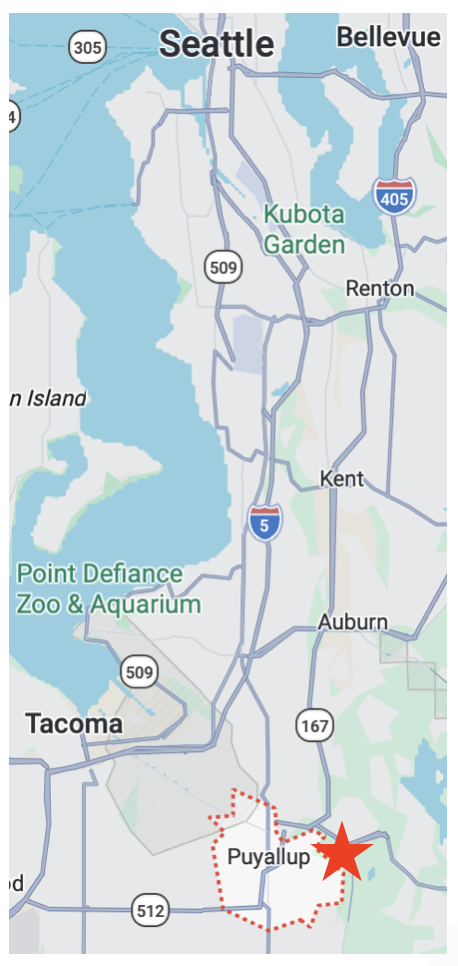
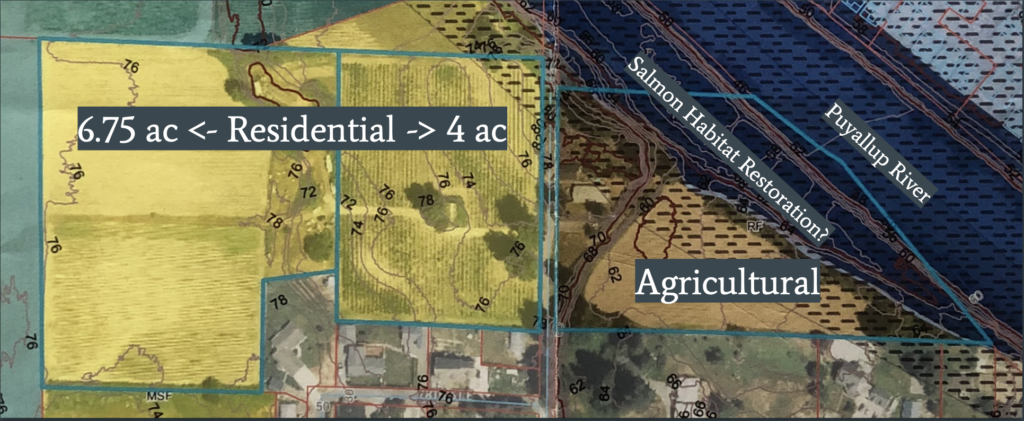
The farm consists of three contiguous tax parcels of land totaling 17 acres in Pierce County, WA. Two of the parcels (10.75 acres) are within the City of Puyallup’s future urban growth boundary, zoned for residential both in Pierce County and in the City of Puyallup’s long term zoning plans. Our plan is to develop as a group of clustered homes, thereby preserving as much of the land as possible while still satisfying the critical identified needs for more middle housing in the area.
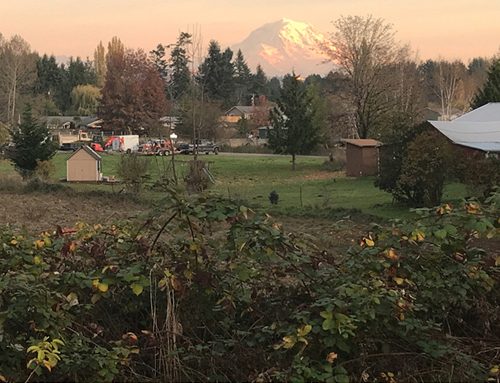
Photos of Land
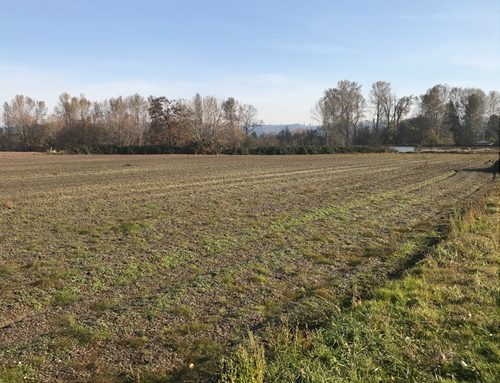
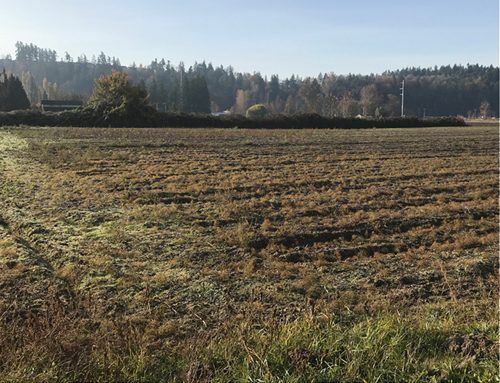
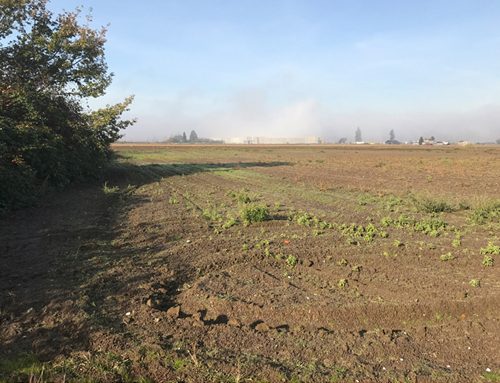
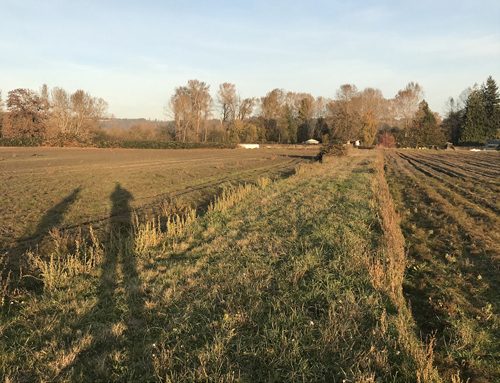

The Site
History of Unit Development Concepts
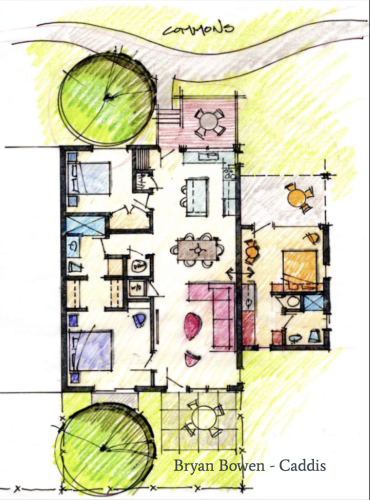
We are targeting an ‘ideal’ community size measured as 40-50 adults, instead of the usual measurement of 25-35 units. We are choosing to use bedrooms as a proxy for adults, and settled on a 48 bedroom community. Our initial thinking about unit plans followed the tried and true cohousing approach of maximizing the number of units as zoning would allow. Our zoning allows 4 units/acre and the 1st parcel we are planning to develop is 4 acres. So our first concept was 16 3bed/2bath units, with one of the bedrooms configured to act as a tiny home with ~300 sq ft of space that includes a bath and a kitchenette. Below are the sketches of our first plan courtesy of Bryan Bowman of Caddis.
Summer 2024: First 1500 sq ft 3/2 Unit Floorplan Concept
Our initial building block was a ~1500 sq ft, 1 story, 3 bedroom/2 bath unit designed for easy sharing and co-living. Each bedroom would have access to the core as well as individual entrances to the outside. One of the bedrooms would be oversized (~300 sq ft) to function as a studio or ‘tiny home’ with its own bath and kitchenette.
This layout was designed to be easy for either conventionally stick-built construction onsite, or 14’x44′ modular units built in a factory and trucked to the site.
The intent was to allow for easy sharing as desired. Some scenarios: a large family in the whole space; a smaller family in the 2/1 with an unrelated occupant in the ‘tiny’; or three unrelated individuals. The amenities in the common house would serve as a valuable extension of the living quarters.
Summer 2024: Flipped for a 3000 sq ft 6/4 Duplex
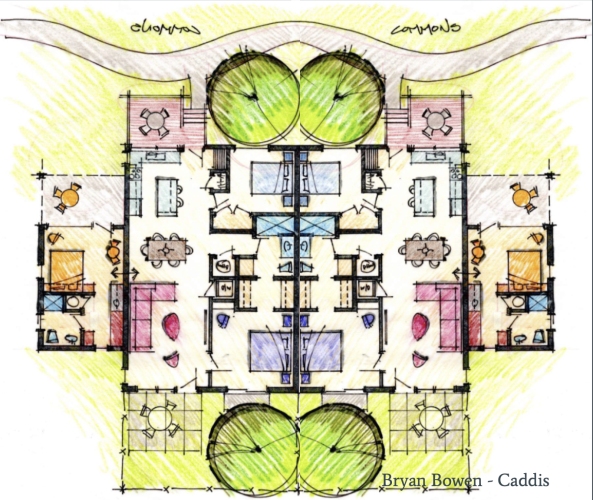
Duplex design is a compromise that preserves more land and open space at the expense of a shared wall.
Looked at through the lens of design for sharing/co-living begs the question: Could we reduce costs by designing this to be a 3000 sq ft ‘McMansion’ with our 6 bedrooms and 4 baths instead of a duplex? Some duplicated space could be eliminated and many construction costs are assigned as a function of ‘units’ and not ‘people’…
Fall 2024: Evolution of Unit Concepts
In September of 2024, just as we were prepared to proceed by asking our civil engineer to prepare the design package for a permit application for a 16 units arranged as 8 duplexes on the 4 acre parcel, we became aware the Pierce County was undergoing a 10-year update to it’s comprehensive plan due on Dec 31st, 2024. For an anxious few months it looked like our zoning would be cut in half in the new comp plan, only allowing 2 units per acre! (In late December, days before the plan was to be submitted, the county approved our amendment which restored our original 4 unit/acre zoning. YAY!)
In the meantime, the unexpected zoning challenge encouraged us to consider alternate schemes for housing 48 bedrooms which involved more and more sharing in the units. Below are concepts we developed showing sixteen 3 bedroom units, twelve 4 bedroom units, and eight 6 bedroom units. Note that the percentage of ‘tiny home’ bedrooms grows as the unit count shrinks. An unexpected side benefit was the realization that fewer units engenders fewer costly unit-based county fees…
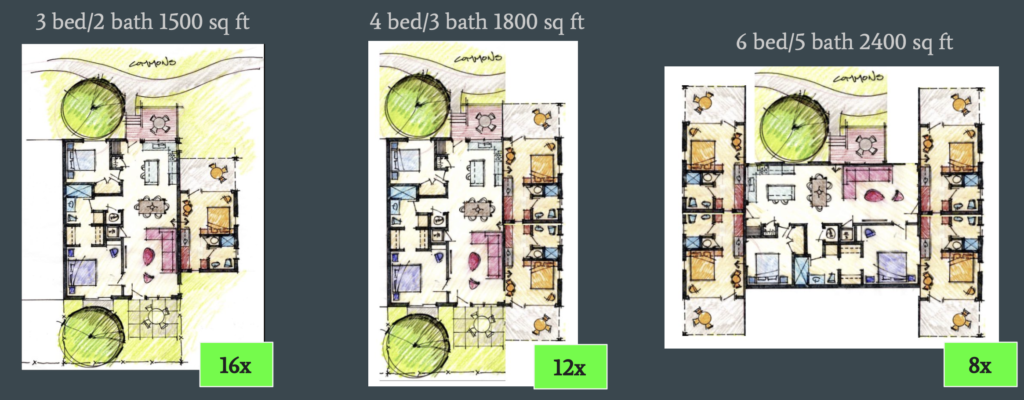
Spring 2026: The 6 bdr/5 ba concept is attractive to us
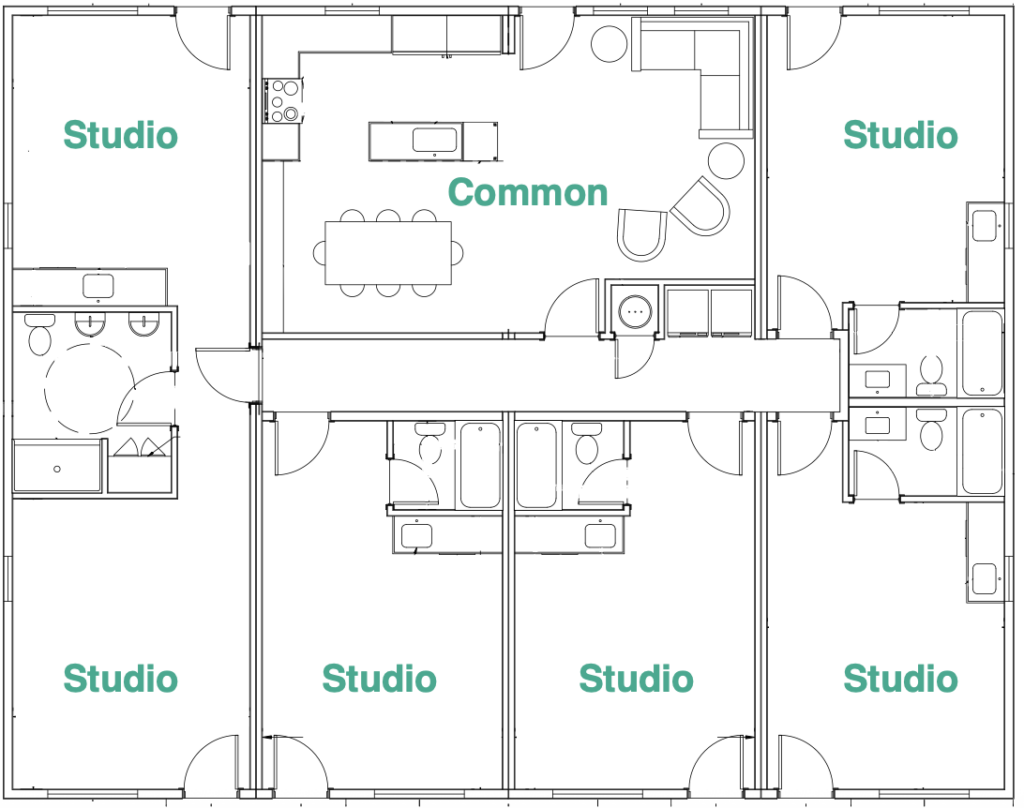

We made our first land use submission to Pierce County in May 2025, just as the new zoning and building codes were being finalized. Confusion reigned supreme as the county employees absorbed the new codes. Back and forth negotiations continued for many months until we satisfied the county requirements with the plan shown to the left.
This floor plan significantly lowers the cost of entry into the cohousing community, particularly for individuals who start with a ‘tiny home’ studio bedroom while still benefiting from the full range of community resources. Unlike standalone backyard ADUs, which often isolate occupants, our model integrates private spaces within a larger, interconnected house and cohousing community. Every resident will have access to shared amenities, including the common house, gardens, workshops, and other collective spaces, fostering a more social and supportive environment.
A single, highly standardized floor plan simplifies construction and maintenance while offering flexible living arrangements. Depending on their needs, we anticipate that residents could purchase or rent living spaces of roughly 300, 600, 1200, 1500, 1800, 2100, or 2400 square feet. With modular construction, each home arrives in four pre-built sections, ready for rapid assembly. This efficiency allows homes to be built and installed within weeks rather than months, reducing construction costs and minimizing disruption to the community.
The flexible design naturally accommodates residents as they transition through different life stages—from singles to couples, to families, and back again. By integrating adaptable financial and legal structures, we aim to make it easy for residents to scale their living space up or down as their needs evolve. This ensures long-term stability, affordability, and the ability to remain within the community throughout different phases of life.
An additional benefit of this layout is that Pierce County has a section in the new building codes that explicitly allows ‘rooming houses’ on our property which we hope will speed up permit approval!
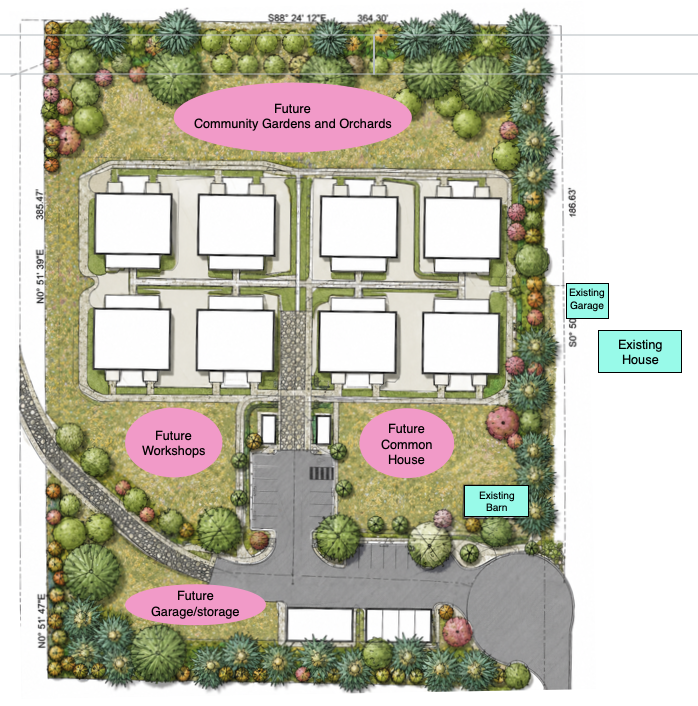
Spring 2026: Preliminary Site Layout Sketch - Phase 1
This site layout shows the eight 6-bedroom units on the 4 acre parcel which will support our ideal community size of 40-50 people if our preferred concept of co-living is successful.
We anticipate that we will build the eight modular residences serially rather than all at once. The existing house and garage next door (shown in blue) can be used as our initial common house until we have a sufficient population moved in to decide on further common amenities like: the ‘real’ common house, gardens, workshops, playgrounds, and the like.
We anticipate that development of the Phase Two 6.75 acre parcel won’t begin until the Phase 1 parcel is largely occupied. We hope that learnings from the development of the 4 ac parcel will allow us to make improvements on the 6.75 acre parcel.
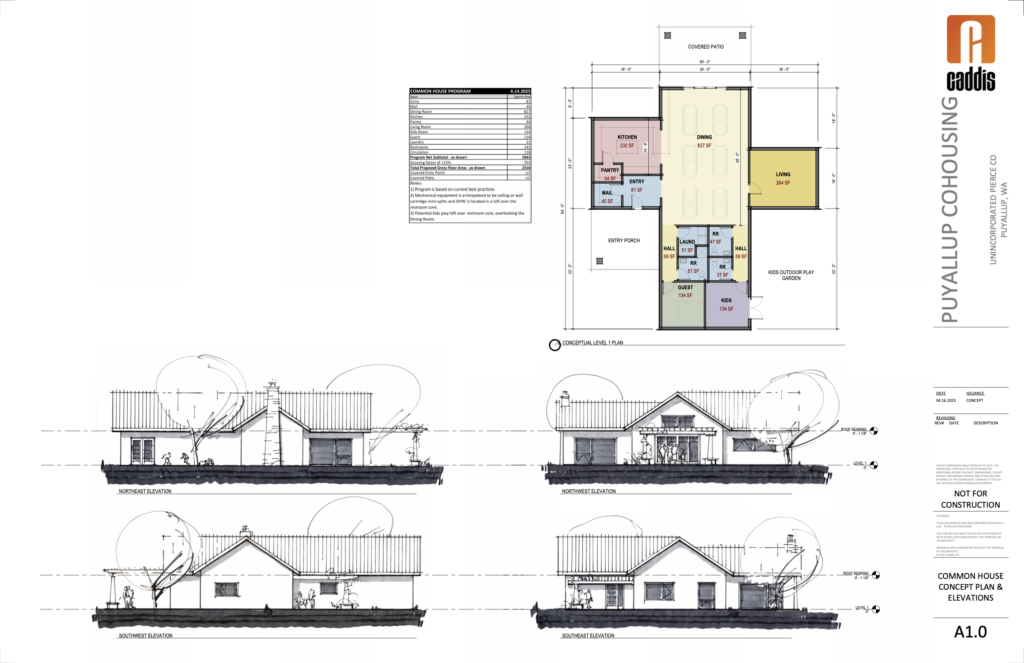
Preliminary Common House Sketch and Elevations
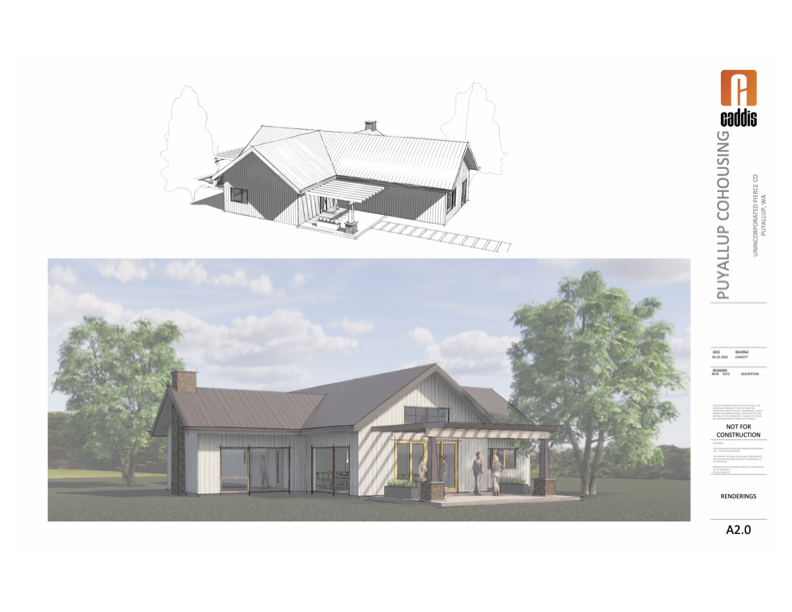
The diagram to the right includes a preliminary floor plan layout and elevations for a ~2000 sq ft common house.
Our plan is to use the existing ~1500 sq ft 3/1 house and ~600 sq ft garage on the 3rd parcel as a ‘starter’ common house. This will allow us to defer costs of constructing the ‘real’ common house until a critical mass of the community occupies.
May 2026: Current Development Narrative
Philosophy
Puyallup Cohousing envisions a high-functioning cohousing community designed to support shared living, flexibility and affordability. Our goal is to provide an innovative cohousing housing model that offers an alternative to traditional single family homeownership in favor of shared housing. Our model is designed to be supportive of both co-living , co-buying, and rental solutions. We are abandoning the standard definition of ideal community size as measured by ’25-35 units’ in favor of measuring ideal size as ’40-50 people’ (with bedrooms used as a proxy for headcount).
Occupancy
Most current cohousing explicitly designs each home for single-family occupancy to ‘fit like a glove‘. We are deliberately designing each home to support shared occupancy and ‘flexibility of use‘. We are inspired by the state of Washington’s recently passed House Bill 1998 encouraging co-living as a partial solution to our current housing crisis.
Development strategy
We are abandoning the standard ‘community led’ approach in favor of ‘developer led’. This implies that our development strategy will be ‘backwards’ compared to the usual cohousing schema. The developer will finance and make all of the key decisions regarding land, site layout, unit layout, legal structure and costs first. The group formation will be last with members only opting into the development if they like the choices made – similar to what happens in an existing cohousing community when a unit is offered for sale. We will need to develop an explicit method of socialization rather than relying on socialization happening during the endless meetings typical of community-led development. As Chuck Durrett is fond of saying: ” If it doesn’t work socially, why bother?”
We accept the fact that the risk to the developer is HUGE in going so far off the beaten path with an untested concept.
Phased development – two communities
Our Phase 1 community will accommodate approximately 48 people across eight single-story, six-bedroom homes on a 4 acre parcel. Each of the 8 buildings will be approximately 2,400 square feet, contributing to a total of approximately 19,200 square feet of living space. Our intent will be to try and have at least one person per studio, with each studio designed as a “tiny home” including kitchenette, private bath, and separate entrance. All studios will be designed with two doors: One door will access the house core and another door serving as a private access. Designed to promote co-ownership, co-living, or shared rental opportunities, these homes will create a versatile and flexible living environment. It will be essential for the occupants of each building to decide on the ground rules regarding access and use of the shared space, i.e. what interior doors are open or locked.
The Phase 2 community site plan is yet to be determined. Our intent is to use the initial community on the 4 acre parcel as a ‘cycle of learning’ that will help us improve on the 6.75 acre parcel. The zoning that parcel is identical to that of our 4-ac Phase 1 and will allow many additional buildings for a second community.
Modular Home Construction
To maximize efficiency and reduce construction costs, each home is composed of four factory manufactured modules. The factory is located in Battle Ground, WA, approximately 130 miles from the site. The dimensions of each of the four modules are 14′ x 44’, or approximately 600 sq ft. This standardized approach simplifies the building process while maintaining high-quality construction. Using modular units dramatically reduces the unit construction timeline. It is not unusual for the typical stick-built development to take 20 months (including site prep) – the modular units are constructed indoors in a factory in 20 days! They are then trucked to the site to be placed on a foundation. There is no financial incentive to construct all of the homes at once as is normal with a stick-built development. The modular units are built to exceed International Residential Code (IRC) and International Building Code (IBC) standards, ensuring durability and long-term performance. With a single floor plan repeated across all homes, this design approach enhances consistency and cost-effectiveness without sacrificing comfort or functionality.
Common House and Shared Spaces
The cohousing community will eventually build a common house of approximately 2,000 – 3,000 square feet with shared amenities tailored to the needs of residents. We anticipate two common houses, one for the Phase 1 community and one for the Phase 2 community. To reduce initial costs, the Phase 1 community will start by repurposing an existing 1,500-square-foot home and 600-square-foot detached garage on an adjacent property to serve as an interim common house. As the community grows, residents will build a permanent common house, the location of which will be included in the site plan from the outset.
Incremental unit placement
Our site development strategy will attempt to separate the ‘horizontal’ site development costs such as roads and utilities into one financing draw – not unlike the development of a mobile home park. By separating ‘horizontal’ site work from ‘vertical’ unit construction, we hope to avoid the financial burden of building all eight homes at once as is typical in ‘stick-built’ construction. With the utilities in place at each home site, modular homes will be placed one at a time as demand grows. We anticipate that this strategy will reduce upfront capital costs and financial risk. Each modular home can be built off-site and transported to a pre-prepared foundation, allowing for efficient installation. With a factory build cycle of approximately 20 days per unit this approach mitigates the risks and delays associated with traditional 1-2 year stick-built construction timelines.
Accessibility and Inclusive Design
Accessibility is fundamental to our design philosophy. We are developing each building to comprehend Universal Design standards, incorporating features such as: single story construction, 36-inch-wide doors, and roll-under sinks. These elements ensure that residents can age in place comfortably, fostering a long-term, inclusive living environment. As the saying goes: “If we’re lucky, we’ll all live long enough to be disabled.”
Legal and Financial Structure
To promote affordability and financial sustainability, we are exploring alternative ownership models such as a limited-equity cooperative, a condominium where each unit in turn is composed of 6 bedroom condominiums, or a condominium where unit is an LLC. The goal is to balance flexibility, collective decision-making, and long-term affordability while minimizing speculative pressure on housing costs. Our chosen legal framework will ensure that residents have financial accessibility and security while fostering a strong sense of community. We may or may not accept outside investors depending on the legal structure that we choose.
Schedule and Costs:
We submitted our first land use plan to Pierce County on May 16th, 2025 attempting to grandfather our application under the old building codes. Much to our delight, the new building codes were actually MORE favorable to our cohousing plans than the old! Following a December, 2025 meeting with the county, we ended up withdrawing our previous plans grandfathered under the old building codes and agreed to submit a new, modified, application. We just submitted our revised permit application in May, 2026.
We plan to create a pro forma and schedule for the project after we see the comments from the county regarding the submission.
Conclusion
By integrating thoughtful design, shared resources, and innovative ownership models, Puyallup Cohousing will offer a truly inclusive, adaptable, and financially accessible living environment. Our vision is to foster a vibrant, interdependent community where individuals can thrive—today and in the future.